1

Place an Order

  • The NavDx test is ordered by licensed clinicians via paper Testing Requisition Form (TRF) or through the online Provider Portal.
  • The NavDx Surveillance Testing Program lets you place a single annual order that covers a full 12 months of testing—no need to reorder each time. You set the cadence (every 3, 4, or 6 months) and can adjust it at any time.
  • See the Order NavDx→ page for full ordering instructions and requisition forms.
2

Collect the Sample

  • The kit is sent to the ordering provider’s office (or directly to the patient, if using NavDx®-Arranged Phlebotomy).
  • No patient preparation is required.
  • 8 mL of whole blood is collected via standard phlebotomy into a Streck tube, which is provided in the NavDx collection kit.
  • The sample is shipped to the Naveris laboratory at ambient temperature on the day of collection using the prepaid FedEx mailer included in the kit.
3

Choose a Phlebotomy Option

  • Naveris offers flexible blood draw options to keep patients on track and reduce missed tests:
    • In-office or facility draw: Standard blood draw at your clinic.
    • NavDx-Arranged Phlebotomy: Naveris will work directly with the patient to arrange a mobile phlebotomist to visit the patient at their home, workplace, or another location of their choice. The patient can also choose to have their draw completed at a local walk-in clinic that is conveniently located to them.
  • When Naveris arranges phlebotomy, patients are more likely to complete testing compared to relying on in-office blood draws. 10
4

Receive Results

  • Results are delivered to the ordering Provider within 7 business days of specimen receipt at the Naveris laboratory.
  • When Naveris arranges phlebotomy, draws can be scheduled in advance of follow-up appointments, so results are available when the patient arrives.

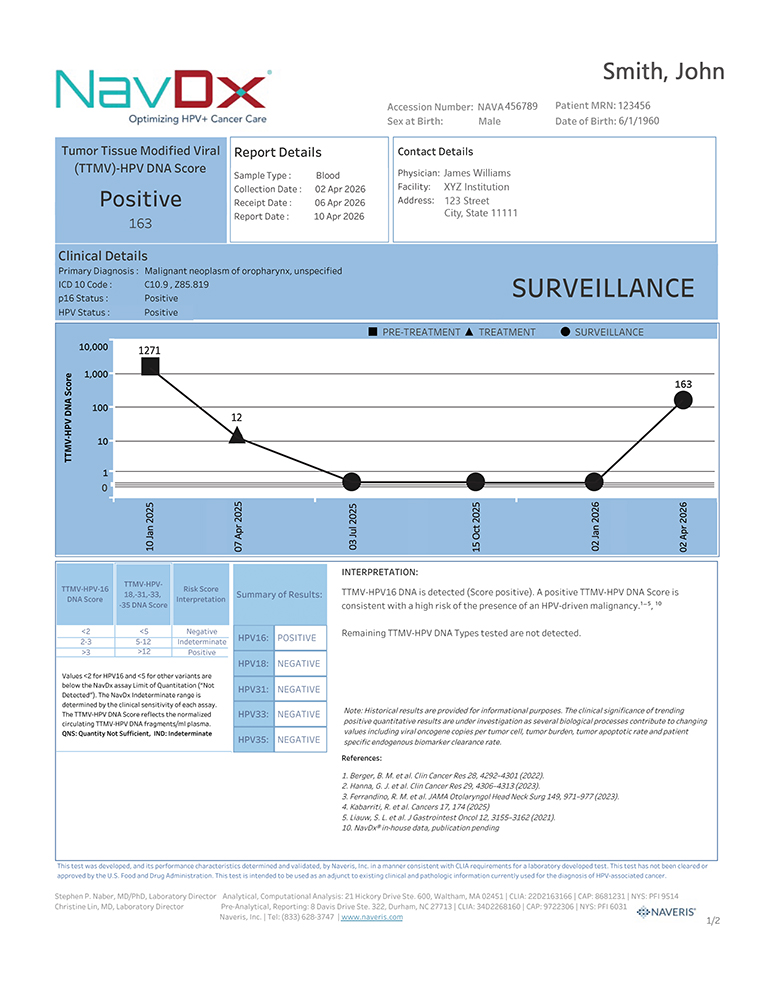
Positive Result


TTMV-HPV DNA was detected in the blood at the time of the draw. A positive result does not confirm active cancer. It is a signal that warrants further clinical investigation.

Suggested patient language:

  • “The test detected a signal we want to investigate further. It doesn’t necessarily mean the cancer is back, but it means we need to take a closer look.”

Negative Result


TTMV-HPV DNA was not detected at the time of the draw. With a NPV of ≥98%, a negative result is highly reassuring. It means active HPV+ cancer cells were very unlikely to be present at the time of the blood draw.

Suggested patient language:

  • “Good news. There’s no sign of active HPV+ cancer in your blood today. This is what we’re hoping to see at every check.”

Important framing: A negative result does not mean cancer can never return. Continued regular surveillance remains essential. This result is a reassuring data point, not a discharge.

Indeterminate Result


The test could not produce a clear positive or negative result for this draw. Indeterminate results occur in approximately 3% of OPSCC tests and 1.3–1.9% of ASCC tests, significantly less frequently than conventional surveillance methods, which produce clinically indeterminate findings in up to 40% of visits.

Suggested patient language:

  • “The result was unclear this time, which happens occasionally. We’ll repeat the test in about a month to get a clearer picture.”

References